

The Most Reliable Ways to Build Mental Strength for Climbing
(And Why It Matters More Than Raw Power)
There’s a version of climbing culture that’s obsessed with strength.
Finger strength. Core strength. Shoulder strength. Numbers on a hang board. Numbers on a spray wall. Numbers that tell you, definitively, whether you’re getting “better” or not.
But most climbers who’ve been around long enough know a quieter truth:
At some point, your progress stops being limited by your body and starts being limited by your head.
Not because you’re weak-minded. Not because you “don’t want it enough.” But because climbing is one of the rare sports where mental strength isn’t optional. It’s baked into the experience.
Every session asks you to make decisions under pressure. To try hard when success isn’t guaranteed. To fail publicly. To regulate emotion while your forearms scream. To stay present when distraction would be easier.
As Unblocd put it in their excellent piece on the mental side of climbing:
“Climbing is as much a psychological challenge as it is a physical one. The way you think, feel and respond while climbing can have just as much impact on performance as strength or technique.”
— Unblocd, “Why Care About the Mental Side of Climbing”
If you want to #startstrong in 2026, whether you’re returning after a break, trying to find consistency, or simply wanting climbing to feel better again, mental strength is where to begin.
Not in a mystical sense. Not through affirmations or hype. But through reliable, trainable skills that support how you climb.
Below are the most effective ways to build mental strength for climbing, without turning your pastime into a self-help project.
1. Learn to Stay Calm Under Pressure (Instead of Fighting It)
Climbing doesn’t reward panic.
When the pump hits, or a move feels uncertain, the instinct is often to rush: to muscle through, to over grip, to stop breathing properly.
Mental strength starts with recognising that pressure is information, not danger.
Elite performers across sports talk about this constantly. Calm isn’t the absence of stress; it’s the ability to operate while stress is present.
In climbing, calm looks like:
- Taking an extra breath before committing
- Trusting foot placements instead of re-adjusting endlessly
- Accepting discomfort without immediately reacting to it
This is a skill, not a personality trait. And it’s trained by exposure, not avoidance.
The more often you climb in a slightly uncomfortable state, without rushing or bailing, the more familiar it becomes. Calm grows out of familiarity.
2. Build Confidence by Trying Hard (Not by Succeeding)
One of the biggest myths in climbing is that confidence comes from success.
It doesn’t.
It comes from proof that you can commit, regardless of outcome.
Climbers who only try when they think they’ll succeed often look confident, until they aren’t. When a move feels uncertain, their effort drops, hesitation creeps in, and suddenly the grade feels impossible.
Mental strength is built by repeatedly showing yourself:
“I can try properly, even if I fail.”
This is backed up by sports psychology research, which shows that confidence is a behavioural skill, not a feeling. You act confidently first; the feeling follows.
In practice, that means:
- Giving moves real attempts instead of “feeling them out” indefinitely
- Accepting failure as data, not a verdict
- Measuring sessions by effort, not sends
This alone changes how climbing feels.
3. Get Comfortable with Failure (Without Romanticising It)
Climbing involves a lot of falling off. Literally and metaphorically.
Yet many climbers carry failure as something personal — a reflection of ability, worth, or potential. That’s heavy baggage for what is, ultimately, a movement puzzle.
Mental strength isn’t about enjoying failure. It’s about recovering quickly from it.
Resilient climbers:
- Don’t dwell on individual attempts
- Reset emotionally between goes
- Stay curious instead of self-critical
Unblocd make this point clearly:
“Climbers who can detach their sense of self from success or failure tend to perform better and enjoy the process more.”
This is resilience in its simplest form: the ability to keep going without spiralling.
And like everything else in climbing, it improves with repetition.
4. Train Attention and Presence (The Forgotten Performance Skill)
Most climbers don’t lose attempts because they’re too weak.
They lose them because they’re not fully present.
Thinking about the last move. The grade. Who’s watching. Whether they should have rested more. Whether this is “their style.”
Mental strength includes the ability to put your attention exactly where it needs to be right now.
Sports psychology refers to this as attentional control. It’s one of the strongest predictors of performance across disciplines.
In climbing, presence looks like:
- Focusing on the next move, not the top
- Feeling body position instead of analysing it mid-move
- Letting go of internal commentary during attempts
This doesn’t require meditation retreats. It requires noticing when attention drifts and gently bringing it back.
5. Trust Yourself More Than Your Inner Narrator
Every climber has an internal voice.
Sometimes it’s helpful. Often it’s not.
“This is too hard.”
“I should be better than this.”
“Everyone else makes this look easy.”
Mental strength involves learning which thoughts deserve attention and which are just background noise.
Self-trust in climbing isn’t blind optimism. It’s the confidence that:
- You’ve prepared enough to try (not do… try)
- Your instincts are worth listening to
- Not everything needs to be over-analysed
Patience grows out of this trust. So does consistency.
When climbers stop micromanaging themselves, sessions feel lighter. Attempts become more fluid. Progress sneaks up quietly.
A Note on Competition Climbing
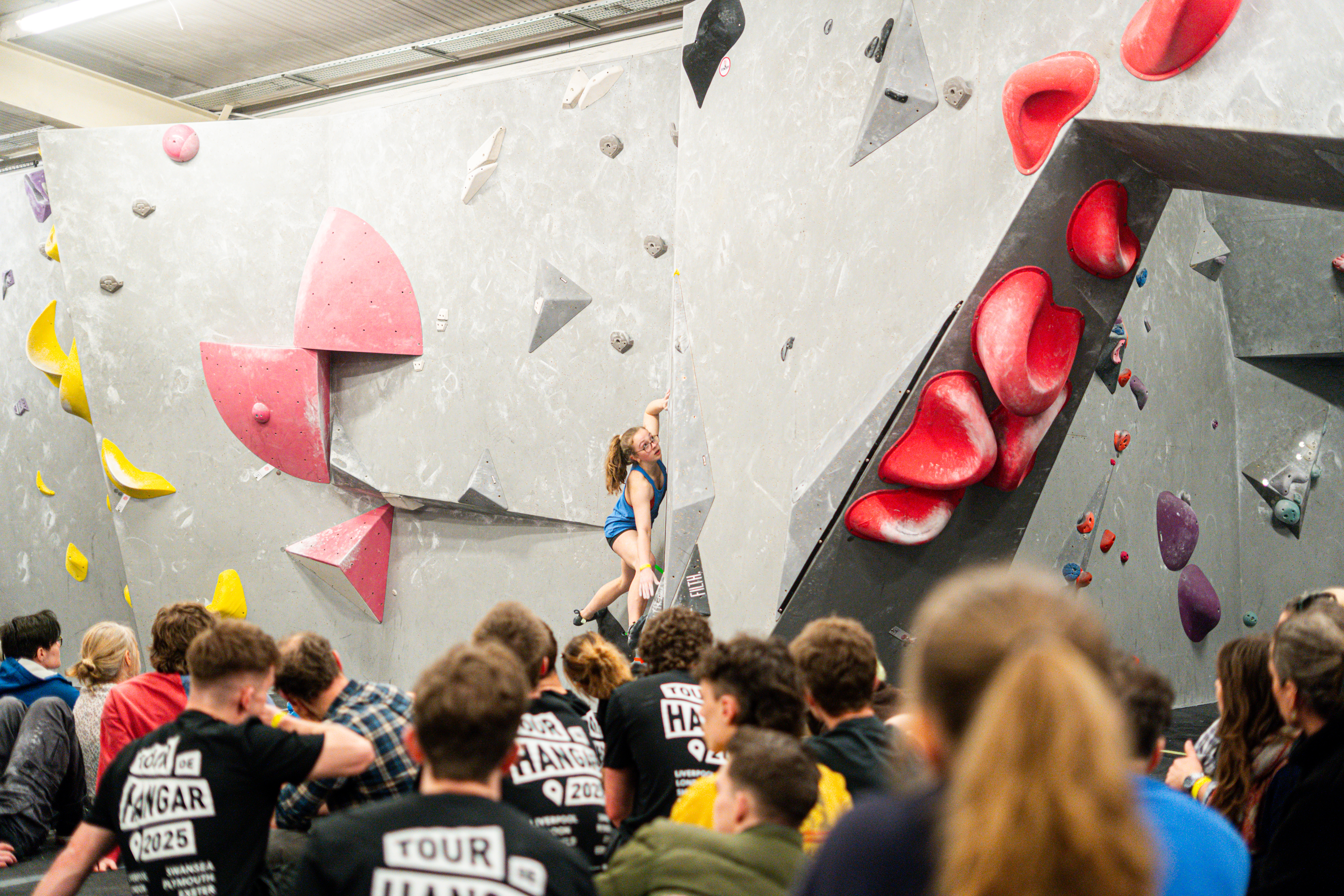
Even if you never compete, competition climbing highlights mental strength in its purest form.
One chance. Limited information. An audience watching on.
The climbers who thrive aren’t always the strongest. They’re the ones who:
- Commit fully
- Reset quickly
- Trust their decisions under pressure
You don’t need to be Team GB to learn from this. Every hard boulder problem offers the same mental challenge, just without the crowd.
Why Mental Strength Makes Climbing More Enjoyable
There’s a strange side effect to mental strength that rarely gets mentioned:
Climbing becomes more fun.
Not easier. Not always more successful. But more satisfying.
When you’re calmer, more present, and less outcome-obsessed, sessions feel richer. Failure stings less. Success feels earned rather than fragile.
You stop bracing against the experience and start engaging with it.
That’s a strong place to start a year.
Final Thought
Mental strength isn’t about positivity.
It’s about reliability.
The ability to show up, try hard, stay present, and recover, session after session.
If you want to build that kind of strength in 2026, surround yourself with good problems, supportive people, and environments that reward process over pressure.
And if you want regular ideas, perspectives, and tools to help you climb better (physically and mentally) subscribe to The Climbing Hangar emails and stay in the loop.
No hype. Just useful stuff.
Related Blog Articles
Back to Blog Go to this article