

Every January, climbing walls fill up with good intentions.
New shoes. Fresh chalk. Big goals written on the first page of a new Moleskine notebook, or maybe the Notes app of your phone:
“To do: get strong.”
“To do: climb the white circuit”.
“To do: warm up”.
“To do: stop avoiding the slabs”.
But then, quietly, by late February, things drift back to normal.
Sessions get skipped. Motivation falls. Life happens. The shoes end up under the stairs. The Moleskine notebook gets lost on the train.
This isn’t a willpower problem.
It’s not a motivation problem.
It’s a habit problem.
Resolutions Feel Grand. Habits Actually Work.
Resolutions get us every time because they feel decisive. You draw a line in the sand. New year, new you. Big outcomes, big crimp energy.
The problem is that resolutions ask your brain to care about an abstract future version of yourself, one that’s fitter, stronger, more disciplined. Habits, meanwhile, deal only in the boring day today: what you do on a Tuesday night when it’s raining and you’ve had a long day at work.
Psychologists have known this for years. Behaviour change research consistently shows that environment and routine outperform motivation. When a behaviour becomes automatic, it requires less effort, less emotional negotiation, and less self-belief.
Or, as the team at Unblocd, the climbing gym for mind, put it in their piece on climbing routines:
“Habits reduce the friction of decision-making. When you don’t have to decide if you’re climbing today, you’re far more likely to actually do it.” Unblocd, “Climbing Habits & Routines”
Climbing progression is not different than any other positive change to a routine.
Not through legendary sessions once in a while.
Not through occasional suffering and long periods of recovery.
But through showing up, again and again, in a way your body and brain can tolerate.

Why Most Climbers Plateau
If you climb regularly, you’ve probably felt it: that flat, frustrating period where nothing seems to happen.
You’re still climbing. Still trying. Still putting the effort in. But the grades don’t budge, and the psyche-well runs dry.
What’s usually happening isn’t a lack of strength or skill, it’s just inconsistency disguised as maximum effort.
Random sessions. Random intensity. Random focus.
One week you climb four times and cook yourself. The next week you manage one half-hearted session. Warm-ups come and go. Sessions blur together. You can’t quite remember what you worked on last time.
Progress hates randomness. It loves a habit.
The Unsexy Truth: Climbing Is Built on Boring Repetition
There’s a strange contradiction at the heart of climbing culture.
We love novelty (new problems, new holds, new gyms, new shoes) but improvement comes from repeating the same sensible behaviours long after the novelty has worn off.
The climbers who get better over years aren’t the most motivated. They’re the most predictable.
They climb on the same days.
They warm up the same way.
They stop before they’re wrecked.
They know roughly what they’re working on each session.
None of this is glamorous. But then climbing isn’t all that glamorous to begin with.
Below are six habits that consistently outperform any New Year’s resolution, especially if you’re stuck at a plateau or trying to get back into the rhythm.

1. Climb on the Same Days Every Week (Remove Decision-Making)
The most powerful habit isn’t about how you climb, it’s when.
Pick your days. Fix them. Defend them.
Monday and Thursday. Tuesday and Saturday. Doesn’t matter. Whatever works. The point is that climbing becomes something you do, not something you consider.
“I climb on Tuesdays”.
Decision-making is exhausting. Every time you ask yourself “Should I go climbing tonight?” you open the door to negotiation, excuses, and fatigue.
Your body doesn’t want to climb. It’s tough. It’s tiring. Don’t negotiate with it. Don’t try to get it on side. Just go.
Habitual climbers don’t negotiate with their body. They just go.
As read over at Unblocd:
“Consistency beats intensity. A routine that you can maintain long-term will always outperform sporadic bursts of effort.”
Climbing on fixed days turns sessions into infrastructure. Like brushing your teeth. Like going to work. You don’t get up in the morning and wonder if you feel like doing it. You just do it.

2. Don’t Drain the Tank (Leave Wanting More)
Overtraining is one of the most common ways that climbers stall, even motivated ones.
Especially motivated ones.
If every session ends in total depletion, recovery never quite catches up. You start compensating. Injuries happen. Psyche drops.
The habit to build is to leave a little climbing on the table.
Finish sessions feeling like you could do more, not like you just lived to tell the tale.
This does two things:
- It improves recovery and reduces injury risk
- It makes coming back easier, psychologically
Progress isn’t made in a single session. It’s made in the space between them.
3. Never Skip the Warm-Up (But Keep It Simple)
Warm-ups fail for one reason: they’re overcomplicated.
If your warm-up requires a spreadsheet, a stopwatch, and perfect discipline, you won’t do it consistently.
The habit isn’t “to warm up perfectly.”
It’s “to warm up every time.”
Same traverses. Same easy circuits. Same movement patterns. Same time: ten minutes, fifteen max.
You’re probably not Janja. You’re probably not climbing all day per session.
Consistency beats creativity when it comes to warming up. Your body learns what’s coming. Injury risk drops. Performance stabilises.
A boring warm-up that you actually do is infinitely better than an amazing one you skip.

4. Plan the Session (Even a Little)
You don’t need a 12-week training plan.
But you do need a point.
Before you arrive, decide one thing the session is for:
- Movement quality
- Tension on steep ground
- Managing your breathing whilst on the wall
- Trying hard on a small number of problems
- Volume on easier terrain
That’s it.
This prevents sessions from dissolving into aimless wandering: pulling on everything, committing to nothing, leaving unsatisfied.
Climbers who plan lightly climb with intention without sucking the joy out of it. No exercise books needed, no mathematical equations.
Just a focal point.
5. Log Your Sessions (Fast, Imperfect, Honest)
Logging works not because it’s analytical, but because it’s reflective.
You don’t need data. You need memory.
Write down:
- Date
- How you felt
- What you worked on
- Anything that stood out
One minute. Notes app. No pressure.
Over time, patterns appear. You see what works. You spot overload early. You stop guessing.
As Unblocd highlight, reflection is what turns repetition into learning.
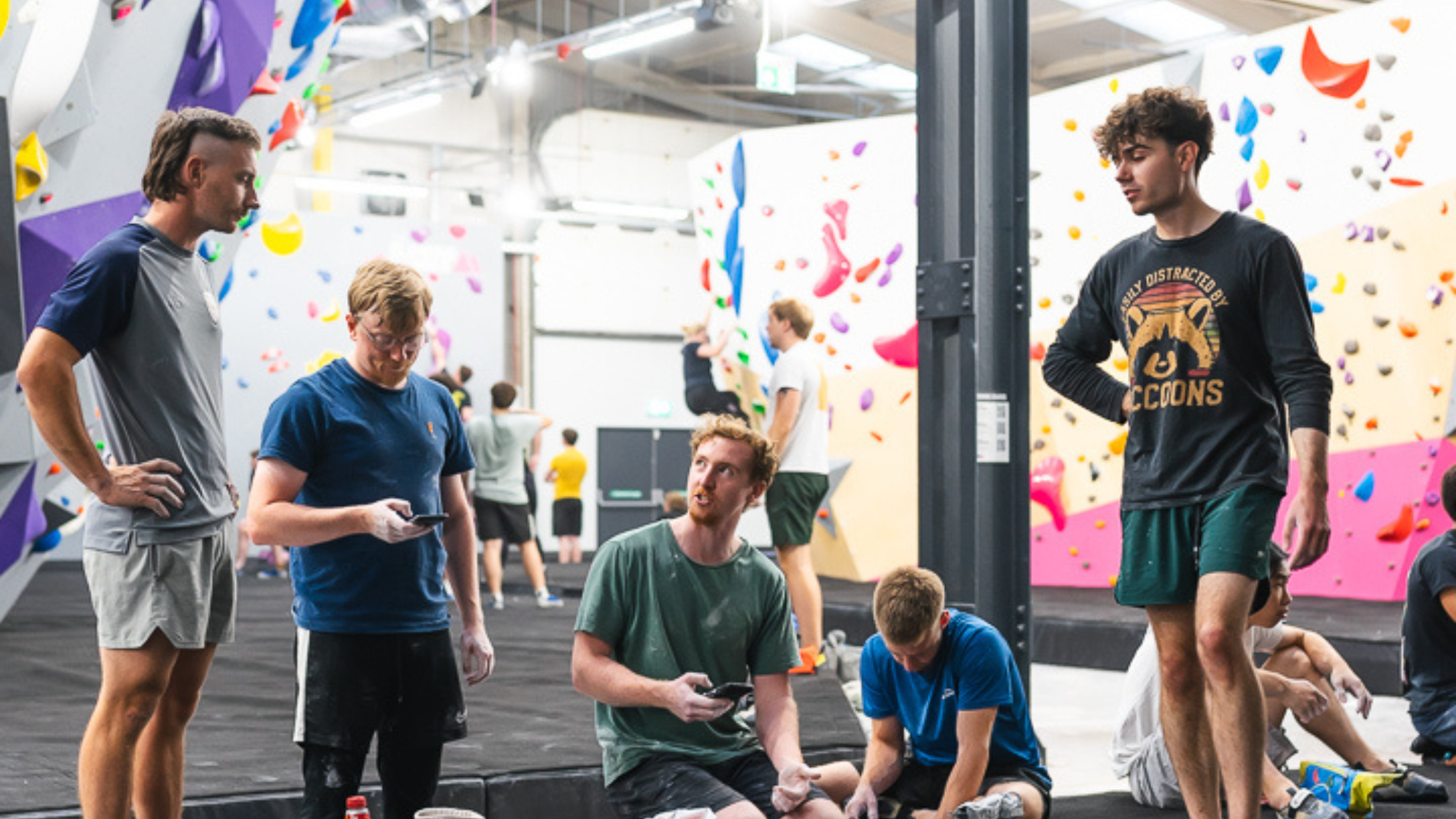
6. Build Social Accountability (If You Really Want to Succeed)
Climbing alone is fine. Improving alone is harder.
This is a team sport.
In fact, social accountability is one of the strongest predictors of consistency in any sport. When other people expect you to show up, you’re far more likely to do it.
This doesn’t mean you turn climbing into a cult. It means:
- Meeting someone at the same time every week
- Being part of a regular session, with shared ideas
- Saying “see you Tuesday” and knowing you will
Community stabilises habits. It’s harder to drift away quietly when people notice you’re gone.
Habits Don’t Feel Dramatic. That’s the Point.
The climbers who make steady progress aren’t usually the loudest power screamers or the most intense trainers.
They’re the ones who’ve quietly removed friction from their routine.
Same days.
Same warm-up.
Same reasonable amount of effort.
Simple reflections.
Familiar faces.
Resolution energy fades, but habits don’t need the hype.
If you’re coming back to climbing this January, or trying to push through a plateau, forget the promises. Build a boring structure first.
Progress will follow.

Bottom Line
You don’t need to want it more.
You just need to make it easier to do.
And if you’re looking for a place where routines form naturally, where showing up is the norm, and where a bunch of psyched, like-minded people want to see you win, then book a session at The Climbing Hangar.
Problems shared. No resolutions required.